sign in


  COBOL TUTORIAL FOR BCA STUDENTS OF M G UNIVERSITY  
  UNIT 3: INTRODUCTION TO COBOL  
   
  HISTORY OF COBOL  
     
 
In 1959, the new language named COBOL (COmmon Business Oriented Language) was introduced keeping in mind the business purpose applications. The board of directorate which is known as CODASYL (Conference on DATA System Language) COBOL programming language committee established a COBOL maintenance committee to keep COBOL in step with the times. The first COBOL compiler became available in early 1962. The next version with some new additions was published in 1965. In August 1968 a standard version of the language was approved by the American National Standard Institute (ANSI). This standard version was again modified in 1974 and is known as ANSI-74 COBOL or COBOL -74. The revision process has been continuous and in 1985 a revised standard was introduced. This standard was known as COBOL-85.
 
   
  FORMAT FOR COBOL PROGRAMS – COBOL CODING SHEET  
     
 
COBOL is a high-level language. Hence, a COBOL program can be executed on a computer for which a COBOL compiler is available. The compiler translates a COBOL source program into the machine language object program. This object program is really executed. COBOL programs are written in coding sheets.

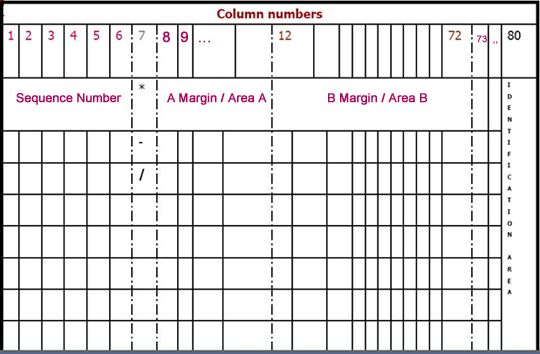
There are 80 columns in a line of the coding sheet. The page number is coded in columns 1-3 and the line numbers are coded in columns 4-6. The page and line numbers together is called the sequence number. Depending on the type, the entries are coded both from column 8 or column 12 and in both cases it can be continued up to column 72. Columns 73-80 can be used to write some identification. The compiler ignores anything that is given in columns 73-80 except when a printed copy of the program is provided by the compiler in which case the entries in columns 73-80 are also listed. The use of the sequence number is also optional and can be omitted. However, when sequence numbers are provided they must appear in ascending order.


Column Field
 
1 - 3
Page Number
1-6 Sequence Number
4 - 6
Line Number
7
Indicator Column
Continuation/Comment
8 - 11
A Margin / Area A
 
12 - 72
B Margin / Area B
 
73 - 80
Identification


In COBOL there are two types of entries known as margin A and margin B entries. Margin A entries start from column 8, 9, 10 or 11 and Margin B entries start from column 12 or anywhere after 12. An asterisk (*) in column 7 indicates a comment line and the entry is not compiled to produce object code. Comment lines are actually some notes revealing the intentions of the programmer. Since the compiler ignores them, anything can be included as comments. Comment lines can appear anywhere after the first line of the COBOL program. A comment line can also be indicated by using the character slash ( / ) in column 7. But in this case the comment line will be printed after causing a page ejection (i.e., after skipping to the top of the next page).